About Greetings to Alice
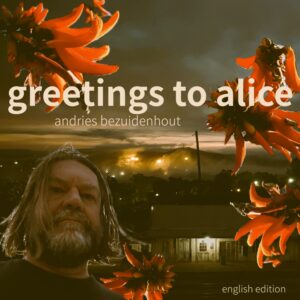
Released on 9 October 2025 – available for streaming here.
This album comes from the heart and the gut rather than the head. My wife Irma and I living in the Eastern Cape has been a theme in my music before, but I have never thought about it as intensely as I did while writing and recording this album – perhaps precisely because, this time, leaving had become a real possibility.
We have lived for almost a decade in a rented house in eDikeni, as Alice is now officially known. It was never meant to be a permanent home. We filled bookshelves, hung paintings on the walls and planted a few trees. Of three citrus trees, only one survived. I began thinking that perhaps somebody else would one day eat its fruit. Irma and I both worked at the University of Fort Hare.
Then, in 2024, on the day I was due to deliver my inaugural lecture as a professor, a series of arson attacks took place at the university. Buildings were damaged and destroyed. For those who work there, the fires formed part of a much longer and more complicated story about the university, its history and its future. Many of us had worked hard to help build the institution. For me, the fires changed something about how I experienced the place. Fire suddenly acquired a different kind of presence.
One of the first songs to emerge from this was Old Beginnings, the English version of Stories van water en vuur. It begins on the road past Dimbaza, where the skeletons of factories still stand, and travels past Nthaba kaNdoda to a house beside the Xesi River, with a piano, books and stories. It is a song about ruins, but also about what remains after ruin. The Afrikaans refrain says: “What is already gone cannot be lost again, but when you rebuild, you do not start from the beginning.” I wrote it, at a fairly low point, as a form of encouragement to myself.
In English, that thought eventually became Always on to old beginnings.
And then, in a very short period, another nine new compositions arrived.
The resulting album, however, did not become an album about arson.
Other places began to assert themselves: Hogsback and the Amathole Mountains, the Gamka River, Van Wyksdorp and the Carlton Hotel, the Tankwa, the sea. Some are places where I have lived; others are places I have travelled through, or where somebody told me a story that refused to leave. Sometimes a place is no more than a mountain pass where you pull over after midnight and look at the sky. Sometimes it contains layers of history that cannot easily be separated from one another.
Two older compositions also found a home on this album about Alice. I wrote one after the death of Lindley, the son of Free State artists Willem and Linda Pretorius. I recorded it at the time and sent it to them as a song of consolation – a requiem. The other is a beautiful poem by Antjie Krog, Huwelikslied II (Marital Song II), from her collection Verweerskrif, published in English as Body Bereft. I set it to music and recorded it many years ago, but never had the courage to release it. I am grateful that Antjie agreed to let me include it here – I used her own translation of the Afrikaans version into English for the version on the album. It is a secular love song written in biblical language.
So instead of being only about Alice, a burning campus and the Eastern Cape, the songs increasingly became concerned with the strange ways in which people inhabit places. We move in and out. We give mountains names. We build houses and lose them. We plant trees whose fruit may be eaten by people we will never meet. We travel unfamiliar roads again and again until eventually they become familiar. We try to remember stories about those who were here before us, knowing that we can never know them completely.
And sometimes we discover that a place we thought was temporary has, in the meantime, become home.
Fire and water began to acquire other meanings too. In several of the songs there are echoes of ukulanda umoya – the practice of returning to the place where someone died to call or retrieve their spirit and bring it home. In Rental, eDikeni, a family comes to collect the spirit of a man killed at our gate. In Old Beginnings, water and fire become ways of remembering and speaking with those who have gone. And in Ash Wednesday, Christian ritual becomes entangled with older practices involving smoke, ash, water and trees – including the mosetlha, or vaalboom. I didn’t set out to connect these things. They seemed to find one another in the songs.
There is also love on this album. Not necessarily the kind announced by roses and laughing doves. In Spiny Kapok and Bitter Bush, love grows among stones, fossils, vultures, bitter bush and the ashes of the previous night’s fire. Elsewhere it is simply someone breathing beside you while the sea breeze moves the curtains. Towards the end of the album it becomes Antjie Krog’s image of a familiar hand unexpectedly resting in yours.
Perhaps love and belonging matter precisely because nothing is permanent.
Two versions
I eventually decided to record the album twice: once in Afrikaans and once in English.
I had asked my colleague and friend Hombakazi Nqandeka to sing with me on some of the recordings. She does not understand Afrikaans – she grew up in a deeply rural part of the Eastern Cape – and I wanted her to understand what the album was about. I also did not want an album initially prompted by arson at Fort Hare to become an internal conversation conducted only in Afrikaans.
But the Afrikaans album is not entirely Afrikaans to begin with. Stories van water en vuur opens with Hombakazi singing in isiXhosa: Unga jiki, jonga phambili – don’t turn back, look ahead. In Aswoensdag (Ash Wednesday) she slips into English: I live my life and I pay my rent / I think I’ll give up crying for Lent.
It began to make less and less sense to think of these languages as separate rooms. The place from which these songs emerge is itself multilingual. Afrikaans, isiXhosa and English constantly pass one another here, speak to one another, and sometimes speak past one another.
At first I thought the English versions would simply be translations. I soon discovered that lyrics do not submit quite so easily. Words have to do more than mean roughly the same thing. They have to breathe inside the same melody. Vowels need to fall in the right places; syllables have to cooperate with rhythm; a line has to be singable. A rhyme that arrives naturally in one language can sound painfully contrived in another. An image that works almost casually in Afrikaans sometimes has to be dismantled and put together differently in English.
And then something interesting happens: the translation starts talking back.
Altyd, altyd vorentoe – always, always forward – became Always on to old beginnings. They are not quite the same thought. But once the English line existed, it seemed to articulate something about the album that I had not quite said in Afrikaans: moving forward does not mean starting from scratch. We carry previous places, people, losses and loves with us.
The English album is therefore not a guide to the Afrikaans one. It is the same group of songs passing through language for a second time. Sometimes the two versions remain very close. Sometimes they wander some distance apart. I decided to welcome the wandering rather than herd all the calves back into their pen.
Afrikaans is, for me, a language with a burdened history, but it is also a language in which I write, dream, joke, argue and hear songs. Allowing these songs to speak English was not an attempt to escape from Afrikaans. It was a way of hearing what might happen to them when they left their familiar home.
Greetings to Alice
The title track arrives relatively late on the album. It concerns the simple act of closing a door for the last time, turning the key, looking back from the gate at the window and roof, and not quite knowing what to do with the moment.
If the album has a centre, perhaps that comes close to it.
Not simply Alice, and not simply leaving. Rather, the tension between leaving and staying; remembering and forgetting; the place you leave behind and the place you carry with you. The fires are part of where these songs began, but fire is not where they end.
There is, after all, always something else to plant. Someone else may eat the fruit.
And sometimes, quite unexpectedly, the lines fall for a while in pleasant places.
GREETINGS TO ALICE – LYRICS
Vocals, musical instruments, programming, recording, mixing: Andries Bezuidenhout
Vocals: Hombakazi Mercy Nqandeka
Master: Willem Möller
[01] OLD BEGINNINGS
Unga jiki, jonga phambili
Unga jiki, jonga phambili
The last train to Dimbaza came and went
Where factory skeletons crouch on cement
Turn left, direction Nthaba kaNdoda
To a concrete monument’s fractured corners
These ruins recall civilisations of old
But this not Constantinople or Rome
Burned-down schools are far more banal
Than a painted dome or the Hagia Sophia
What’s already gone we can’t lose no more
But we still rebuild on what came before
I was born from stubborn stock, raised by pride
In my rear-view mirror I leave this behind
So don’t look back at burning cities
Always on to old beginnings
House with piano at the Xesi River
Where generations of books still remember
How stories and shutters hinge on spines
But how yellowed pages keep words alive
Stories still smoulder long after they’re told
Fed by roots that run deep in this soil
We pour brandy out for those already gone
Camagu, my people, ‘til we too move along
What’s already gone we can’t lose no more
But we still rebuild on what came before
I was born from stubborn stock, raised by pride
In my rear-view mirror I leave this behind
So don’t look back at burning cities
Always on to old beginnings
On some ordinary weekday
When my spirit finally leaves
Please take a moment then
And gather sticks from this tree
Return my bones to fire
With my papers and with leaves
With fire and with water here
All our stories breathe
What’s already gone we can’t lose no more
But we still rebuild on what came before
I was born from stubborn stock, raised by pride
In my rear-view mirror I leave all this behind
So don’t look back at burning cities
Always on to old beginnings
Unga jiki, jonga phambili
Unga jiki, jonga phambili
Unga jiki, qhubeka
Jonga phambili, qhubeka
[02] SPINY KAPOK AND BITTER BUSH
We scaled Grootkloof in the late afternoon
Past Matroosberg and the Swartruggens crest
A butterbush shy in the company
Of golden spurge and wild harpuis
At Cobra Rock you’ll find shaly scours
Stripped to the ancient sandstone scales
A Dinocephalian’s petrified bones
Probably caught in frozen stone
Love is not announced by laughing doves
But instead by vultures and ravens
Love never flowers with roses but rather
In spiny kapok and in bitter bush
Cutlery of hornfels and black basalt
Scattered among bush and stone
And on a rockface, painted down
Ancient outlines in red and brown
At Waaikop Albert Petoors and his kids
Whitewashed their brakdak’s raw clay bricks
The desert wind stripped their home away
But on the barren slope kraal walls remain
Love is not announced by laughing doves
But instead by vultures and ravens
Love never flowers with roses but rather
In spiny kapok and in bitter bush
Last night’s fire was soot and ash
When a scrub robin called from a vygie bush
I found our coffee pot and keys
Among the dishes and bottle debris
Love is not announced by laughing doves
But instead by vultures and ravens
Love never flowers with roses but rather
In spiny kapok and in bitter bush
[03] RENTAL, EDIKENI
Something amiss with the light of a rental
Lightbulbs are cold and walls judgemental
Homes are fleeting, but rentals more so
Rooms of waithood and time on the move
After seven dry years an attempt at planting
Of three citrus trees only one survives
Unborn crops left to future tenants
Bitter grapefruit for a winter breakfast
The story’s moral revealed at the end
On the day that the final accounts are sent
Mountain shapes are more familiar
Got to know some peaks by name and surname
Can predict the movements of people and clouds
But never knowing the reasons why
Over the years our book spines faded
Read by the sun through open curtains
Perhaps someday I’ll move the shelves
And catalogue by genre our temporary stay
Rental contract or ancient design
We cross our names out, line by line
Rusty pipes and mouldy walls
Wine and communion with our rented neighbours
At times a connection that feels quite real
Perhaps in some way we’re part of some deal
Then the shots at the entrance gate
An inkabi seals his bitter contract
You’re there when the branch is laid for his spirit
And we just keep on paying our rent
Rental contract or fairy tale spun
The ledger is closed and the contract is done
[04] THIS SIDE OF LINDLEY
The night sky is neither landscape nor portrait
And stars are not arranged according to law
Due to the mood of cloud or blue gum leave
Stars are sometimes away and then just there
To pull off the road, this side of Lindley
To watch how Pegasus opens his wings
To pull off the road, just after midnight
To witness Pegasus in a nocturnal run
No purpose to anything, just happenstance
Yet sometimes in the scuffle we never less find
An image, a composition, perhaps a pattern
Perhaps in that moment lurks something apparent
To pull off the road, this side of Lindley
To watch how Pegasus opens his wings
To pull off the road, just after midnight
To witness Pegasus in a nocturnal run
Do you also wonder about what the worst is
The fading of forgetting, or the sting of memory
I really don’t know about memory or forgetting
Or the cold that still hangs between then and now
To pull off the road, this side of Lindley
To watch how Pegasus opens his wings
To pull off the road, just after midnight
To witness Pegasus in a nocturnal run
[05] DRIVING FROM EDIKENI TO HOGSBACK
Driving from eDikeni to Hogsback, villages along the way
Turquois and pink paint on walls of wattle and of clay
Then up the mountain pass, though indigenous forests
Yellowwood and monkey creepers, fields of arum lilies
Missionaries fled up the mountain for every summer season
Lovedale’s heat and mosquitos drive anyone up something
Chickens, ducks, and pots, loaded onto ox wagons
Flocks of sheep and goats, even school kids went along
To missionaries the mountain looks like the back of a hog
But long before the amaXhosa saw calves in the clouds
The same peak is moon or sun
It all depends on where you stand
He always walks barefoot to connect with Mother Earth
He says he vibes with that acacia and points to a conifer
People come from everywhere to experience gardens here
Azaleas and rhododendrons and redwoods at the arboretum
Ghosts still roam on Redcoat Lane with stories of war
The Battle of the Axe and all that came before
And later on the Summertons reclassified as coloured
And with the cough of some bureaucrat also lost their vineyards
To missionaries the mountain looks like the back of a hog
But long before the amaXhosa saw calves in the clouds
The same peak is moon or sun
It all depends on where you stand
Drive direction Plaatjieskraal and then scale Tor Doone
There is Monica Wilson’s house over at Hunterstoun
Under her oak they drafted the Charter that promised us our freedom
En Zim Ngqawana’s place of madness on the opposite horizon
To missionaries the mountain looks like the back of a hog
But long before the amaXhosa saw calves in the clouds
Late at night we drive back to the valley, to our home down below
Do you realise we’re not on holiday, you say
This is just where we now stay
[06] ASH WEDNESDAY
She picked a branch from a weeping wattle tree
And in a kettle water she pressed the leaves
Burned some bark and watched the smoke
And thought about what would clear the air
Took the ashes and smeared them on her forehead
And wondered how different things could have been
She says: I live my life and I pay my rent
She says: I think I’ll give up crying for Lent
She picked the leaves of a silver cluster tree
Placed one of them on her lips
Thought about words from mouths and pain
About what we numb with pills and wine
Braided the bark into a rope
For a bridge from here to far away
She says: I live my life and I pay my rent
She says: I think I’ll give up crying for Lent
Old, old couch or a brand-new painting
Sometimes you rearrange, sometimes just stay
Think for a while, weigh things up
Until one day, she just moves on
She says: I live my life and I pay my rent
She says: I think I’ll give up crying for Lent
[07] JUST ANOTHER SOUTH AFRICAN TRAIN SONG
This dignified station is a veteran soldier
Medals are polished, but threadbare seams
Hidden under epaulettes testify of tracks
With wear and tear topped off with rust
Accusations of punctuality completely out of place here
So just wait patiently and read your paper, dear
Now a whistle protests, insistently
Wagons complain as the engine pulls away
Suspended over the Gamka River bridge
A rhythmic silence at the desert’s edge
Window frames move slowly to dreams
This train is a cradle for eternity
In Turner’s era this was new technology
Steam was progress, tracks something new
He paints the smoke, the steam, and the steel
Torque from pigment and hardened oil
Steam or diesel or electricity
Are we sliding back, or moving ahead
Little of this can phase me, actually
Not much to be done about all this from here
Suspended over the Gamka River bridge
A rhythmic silence at the desert’s edge
Window frames move slowly to dreams
This train is a cradle for eternity
Platforms and towns mutely fade
This station stripped, that station stays
Wilted branches but the tree trunk still holds
Onto roots that track moisture and manure
Derelict station, station museum
Trains stand still, or keep on rattling
And who decided to keep this track going?
So much forgotten, so much recalled
Suspended over the Gamka River bridge
A rhythmic silence at the desert’s edge
Window frames move slowly to dreams
This train is a cradle for eternity
I remember that song about the Trans-Karoo
And Matjiesfontein and the one about the spoors
Between trains and stations by Richard and Lochner
Gertjie’s Beaufort and Koos Doep’s phantoms
The Briels cried in country about the train to Pretoria
And Charles Jacobie brings the blue train to the story
Then there’s that one from Hugh Masekela
About workers and mines and the dark stimela
Suspended over the Gamka River bridge
Water only flows here a few times a century
Window frames move slowly to dreams
This train is a cradle for eternity
Blockhouses guarding bridges and steel
With mining explosives, Great-Grandpa at the wheel
The Oosterlyn tracks he blew to smithereens
Shipped off to Ceylon as guest of the Queen
The track terminates at Bitterfontein
The final stop, the end of the line
May I too fade to silence one day
Into the dark like a midnight train
[08] ALICE’S BOOKS
On Alice’s table you’ll always find a book
Stories or poems she picks just for you
Come inside, she says, didn’t hear you knocking
I have scones in the oven and freshly ground coffee
She always enquires about gossip and more
What has happened to that guy who always keeps score
Alice, it is time for me to hit the road
But I don’t want to leave your corner abode
This bookish house, is where I want to stay
Alice, I’m lost, will you help me find my way?
I’m not friends with words, or with what to say
The folks at the office say I’m more than restrained
But when I ask about Alice, she always changes gear
Sends the conversation far away from here
And I find myself again talking about myself
About this book and that movie, I ramble away
Alice, it is time for me to hit the road
But I don’t want to leave your corner abode
This bookish house, is where I want to stay
Alice, I’m lost, will you help me find my way?
You’ll find her now through a hole in the fence
At times I’ll clean the granite, put flowers there
I don’t think I’ll ever know who she really was
But I’ve written this song, just because
Alice, it is time for me to hit the road
But I don’t want to leave your corner abode
This bookish house, is where I want to stay
Alice, I’m lost, will you help me find my way?
[09] BETWEEN THE CARLTON AND THE KAROO
We drove the Little Karoo on trouble money
After a year that nearly broke us clean
Stopped in Van Wyksdorp at a local drinking hole
The barman’s Afrikaans has an English tongue
“Where you folks from?” he asked us with a grin
I said, “Alice now — though Jo’burg long ago”
“My old man came from Jo’burg too,” the barman said
“He spent his whole life working at the Carlton Hotel”
Oh Carlton Hotel, you empty shell
Museum for how dreams can come loose at the seams
Oh Carlton Hotel, you empty shell
Museum for how dreams can come loose at the seams
From behind the counter he told us how his father
Caught the tram from Fordsburg every day
Started out as a waiter, worked his way up slow
At the Koffiehuis Café, that one with the old piano
He said everyone who mattered passed through the Carlton
John and Yoko, Mick Jagger stayed there too
He remembers how Mandela once hosted Paul Simon
Back when even rich men still paid cash
Oh Carlton Hotel, you empty shell
Museum for how dreams can come loose at the seams
Oh Carlton Hotel, you empty shell
Museum for how dreams can come loose at the seams
“Dad saved every tip,” he said, “for a house out in the Karoo”
That very house across the road where I still live today
But a year before the day he would finally retire
He was shot where Fox Street dead ends in Von Wielligh
Oh Carlton Hotel, you empty shell
Museum for how dreams can come loose at the seams
Oh Carlton Hotel, you empty shell
Museum for how dreams can come loose at the seams
And we stepped outside into the hard white sunlight
Passed an old man walking slowly from across the street
“Is my son spinning stories again?” he asked
“Don’t believe a word — his mind’s not right these days”
[10] REGARDS TO ALICE
Another ending, another beginning
You pause for a moment at this door frame
Consider on what you’re turning your back
And if you’ll start elsewhere, again, from scratch
Whereto to drive, where to sleep over
After so many years of diluted comfort
At which mountain pass will you pause
To consider the beauty of euphorbia or aloe
To finally reach to close the door
Turn a key and then look once more
From the front gate, back at window and roof
Still uncertain of what you should do
Just move along because nothing has happened
Nothing to see here, nothing to learn
Cyclical pirouettes of time in a vacuum
That which stops feels so obsolete
To finally reach to close the door
Turn a key and then look once more
From the front gate, back at window and roof
Still uncertain of what you should do
So, buy a ticket rather than a bed
The wind’s direction your only lead
Passage rather than title deed
Manoeuvre rather than sconce or fort
To finally reach to close the door
Turn a key and then look once more
From the front gate, back at window and roof
Still uncertain of what you should do
[11] FROM CONSTANTIA TO THE TANKWA
At the age of forty he lost everything
His house, his pride, and his wedding ring
All he had left was a second-hand pickup
And his cousin’s farm in the Ceres Karoo
Puts a roof on the ruins of a bungalow
Pumps water from an ancient windmill furrow
Long way down from a mansion in Constantia
To a shepherd’s cottage on a farm in the Tankwa
What is his story, what can one say?
Just a man, the Karoo, and disinterested rain
In his outdoors kitchen he befriends the ants
And a mongoose couple as his confidants
An oryx herd comes to drink from the bath
Left just beyond his garden footpath
Replaces rosemary with wild kapokbos
Finds rock art on the verge of fading away
But now still talks of those who once lived here
At night he imagines he can hear what they say
What is his story, what can one say?
Just a man, the Karoo, and disinterested rain
Late afternoon, when the heat subsides
He lays out a trail on the mountainside
His own two feet as pilgrims at stray
Sets stones as guides to show them the way
Stones with lichens and patterns of moss
At times apparent, at times almost lost
On petrified lava, sandstone and gneiss
Of his footpath’s route the stones will cry out
What is his story, what can one say?
Just a man, the Karoo, and disinterested rain
There’s no moral to this pedestrian story
No writing on walls, but on the rockface those figures
And a man with his demons, a man who knows
That ancient ghosts crouch in his campfire’s glow
What is his story, what can one say?
Just a man, the Karoo, and disinterested rain
Dry whirlwind summers, bare winter days
See how the seasons keep colour at bay
[12] WE LIVE NEXT TO THE OCEAN IN A HOLE IN THE SKY
The ocean wind asked for a dance with the curtain
A reel, a polka, a tango, or a waltz
I can hear you breathing next to me
On the pillow your hair, your shoulders free
We live next to the ocean in a hole in the sky
Like Yolande and Breyten, years ago
The balcony door’s frame wide open
Night jars whistle and lapwings cry out
Our lines have fallen unto pleasant places
This goodly advance, purely by chance
Yea, we perch together in this floating abode
Us two together, next to the ocean
Coastal bananas and milkwood trees
The wind is silent but gossipy leaves
Testify of living air
Those leaves that refuse the call to despair
Moon over the sea sets the fog alight
Night heron pair at the river mouth
The oceans hum a call to rest
Soundtrack that puts our dreams to bed
Our lines have fallen unto pleasant places
This goodly advance, purely by chance
Yea, we perch together in this floating abode
Us two together, next to the ocean
In my heart still the contours of Highveld mine dumps
Pilon pillars of steel and the smell of fires
As sacrifice to the coming rebirth
of sugarbush, blue gum, and silver birch
But for now, summer, sun and sapphire
Perhaps we’ll return, but for now we’ll stay on
Where waves crash precisely on a sandy coastline
Where the moon plays games with ocean tides
Our lines have fallen unto pleasant places
This goodly advance, purely by chance
Yea, we perch together in this floating abode
Us two together, next to the ocean
[13] MARITAL SONG 2 (ANTJIE KROG)
Your everyday daily hand in mine
The silence of your thumb
A palm that is always itself
Your hand secretes a mildness
Which I fail to name adequately
If you hold me I breathe
Our love lords over the place
As you weigh in with me until
Words convert guile into glow
Of startling light; you can lift me on stilts
And so sterling, dear, things seldom appear to me.
From the edges you pull me back
And convince me to hereness
To righteousness
For nobody’s name’s sake
Nobody humans language more than you do
Nobody ignites like you
Across borders of leaving and loss
Seamless you fathom, fearless you point
The rot, out of all you have chosen me
But in the meantime you have turned grey
And awkwardly vulnerable in your sheath
For myself you took me in and forged me legitimate
From deep within my lungs I care for you
Your integrity fills the length of our love
My eyes open up all around you
I bequeath my mouth to you
You have searched me and known me
You know my downsitting and mine uprising
You understand my heart afar off
But your hand now, this afternoon
Thoughtfully in mine, reveals
That we are one in flesh and that
You will die, like me
And like me, you will do it alone
And not even death, beloved,
Can sunder us in this